In February this year, The Wall Street Journal profiled a traveller who checked into a hotel in Saratoga Springs, New York, and spent most of her stay asleep. Kaitlyn Rosati slept for 16 hours on the first night, got up for breakfast and a bath, then went back to bed for another four-hour nap. Her itinerary had no galleries, restaurants or must-see attractions. The point of the trip was to do almost nothing.
The idea sounds faintly absurd until you consider how many people now arrive on holiday already exhausted. Rosati had booked what has become known as a sleepcation, complete with a pillow menu, weighted blanket and other sleep-focused extras. Hotels elsewhere are experimenting with sleep concierges, specialised mattresses, blackout technology, soundscapes and wellness programs designed less around entertainment than recovery. Sleep specialists are right to warn that a weekend away cannot repair chronic sleep deprivation, but the commercial signal is still worth noticing: a growing number of travellers are prepared to pay for the privilege of having less demanded of them.
That helps explain one of the more interesting changes underway in hospitality. Hotels are becoming vastly more sophisticated technologically at the same time as many guests are looking for experiences that feel simpler, calmer and more human. The apparent contradiction disappears once you recognise what good hospitality technology is increasingly being asked to do. Its job is not to make the stay feel futuristic. It is to remove the small burdens that make travel feel like work.
The new luxury is having less to manage
For much of the past century, hotel luxury was expressed through abundance: more space, more staff, more dining options, more amenities and more elaborate service. That model is not disappearing, but another form of luxury is becoming easier to see. It is the luxury of reduced cognitive load.
Hilton Hotels & Resorts‘s 2026 global trends research, conducted by Ipsos among more than 14,000 travellers across 14 countries, found that the number-one leisure travel motivation was to rest and recharge. Fifty-six per cent selected it, ahead of motives such as spending time in nature or improving mental health. The same research found that 19 per cent of business travellers would choose sleep over socialising with colleagues. Amadeus, drawing on a separate survey of 6,000 travellers, found that 41 per cent aspired to return from a trip with a calmer nervous system, while a third described an ideal destination as somewhere compelling enough to make a digital detox feel natural rather than punitive.
Taken together, these findings suggest something broader than a fad for better pillows. Travel is increasingly being purchased as a form of restoration. That changes the role of the hotel. A property is not simply the place you return to after experiencing the destination. In some cases, it is the environment that helps restore the attention, energy and equilibrium that everyday life has depleted.
This is why the strongest hotel concepts of the next few years may not be those that give guests the most to do. They may be the ones that make it easiest to stop doing. Quiet rooms, simpler interfaces, fewer unnecessary decisions, better sleep and greater control over interruption can all become part of the value proposition. In a world of permanent alerts and endless choice, relief itself has become a service.
Personalisation is moving from recognition to anticipation
Hospitality has always prized recognition. A good host remembers your name, recalls what you ordered last time and notices the preferences you did not need to explain twice. Digital systems are now making that kind of memory scalable.
One of the clearest examples is the shift towards attribute-based selling. IHG Hotels & Resorts has already rebuilt parts of its booking experience so guests can select room characteristics that used to be left largely to chance, such as a higher floor or a particular view, and then add extras including lounge access, food and beverage credits or parking. When IHG announced the program in 2023, more than 5,000 hotels already had the ability to let guests select room attributes, and the company reported that guests who purchased an attribute spent an additional US$22 per night on average, rising to US$41 in some luxury and lifestyle properties.
That may look like a merchandising innovation, but it points to a bigger shift. Traditional hotel categories are broad proxies for what a guest might value. Personalisation allows the industry to move towards something closer to a segment of one. A traveller might care less about the difference between a ‘deluxe’ and an ‘executive’ room than about being away from the lift, having a firm pillow, getting natural light in the morning and checking out at 2pm. Technology makes those preferences easier to capture, price and fulfil.
AI extends the idea further because it can learn from patterns rather than waiting for explicit instructions. If a regular guest consistently asks for a quiet room, drinks sparkling water, orders tea at 7am and requests a late checkout, a hotel should increasingly be able to anticipate those preferences. The commercial opportunity is obvious, but so is the boundary. Personalisation feels like service when it saves effort. It feels intrusive when guests are unsure what is being remembered, inferred or shared. The hotels that do this well will need to earn permission as carefully as they build capability.
The smartest technology may be the technology guests never see
The most visible hotel technologies tend to attract the most attention: robots delivering towels, kiosks replacing reception desks, voice assistants controlling the lights. Yet some of the more consequential uses of AI are likely to sit much further backstage.
McKinsey & Company and Skift’s work on agentic AI in travel describes systems that can do more than generate suggestions. An AI agent can evaluate information, make a decision and then act. In a hotel, that could mean allocating rooms according to loyalty status, previous feedback and known preferences; using maintenance data and smart sensors to identify a problem before an air-conditioner fails; or dynamically assigning housekeeping tasks according to staffing, check-out times and room status.
Amadeus’s 2026 hospitality research suggests hotel leaders are already moving in this direction. Nearly all 500 hoteliers in its survey planned to invest in AI during the year, and about 60 per cent were already using or planning to use AI for predictive housekeeping and room assignment. The significance is not simply efficiency. When these systems work well, they remove failure points from the guest experience before anyone has to complain.
That distinction matters. A hotel can spend heavily on guest-facing technology and still make people queue, repeat information, chase requests and discover problems the property should have spotted first. Conversely, a hotel can use sophisticated AI without the stay feeling remotely technological. The room is ready when it should be. The maintenance issue never occurs. The request is routed instantly. Housekeeping arrives at a convenient time. The guest experiences competence rather than software.
This is a useful test for hospitality investment: does the technology create another thing for the guest to operate, or does it remove something they previously had to manage? The second category is likely to prove far more valuable.
Automate the transaction, protect the interaction
There is a persistent fear that more automation must mean less hospitality. The evidence suggests guests are more selective than that. They often welcome digital tools for low-value transactions while still wanting people to be available when judgement, empathy or local knowledge matter.
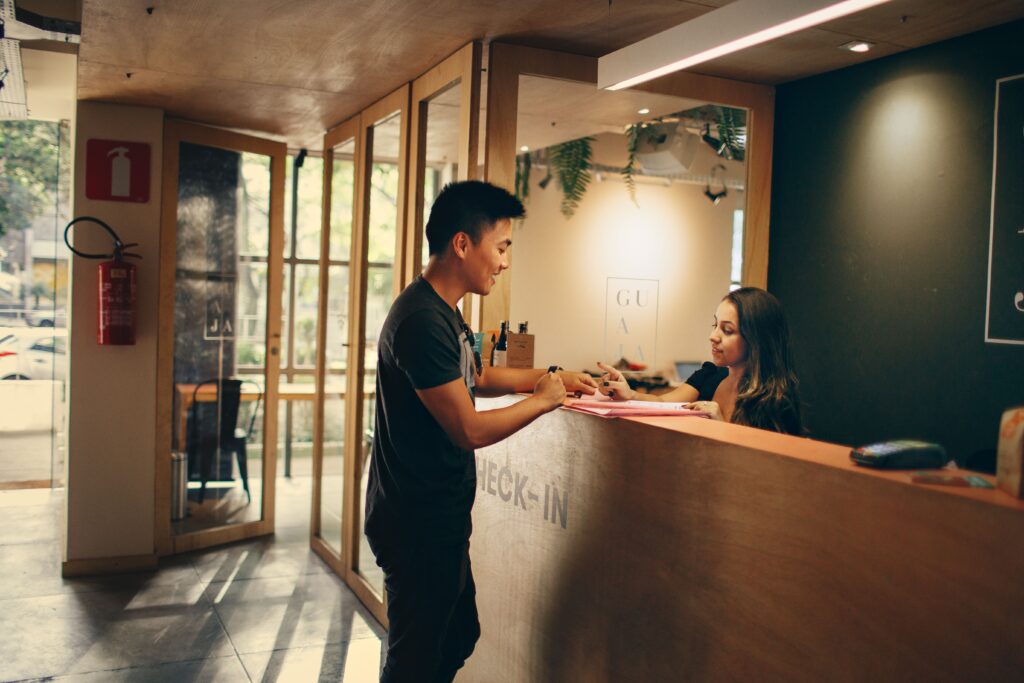
Hilton’s research found that 73 per cent of travellers value some form of digital check-in and check-out. During the first half of 2025, more than 12 million Hilton digital keys were downloaded, 20 per cent more than in the same period a year earlier. At the same time, Hilton reports that its concierges in London are increasingly being asked to validate or improve itineraries first created by AI tools. Travellers appear perfectly comfortable letting technology handle a key, a queue or an initial shortlist, then turning to a person when they want context they trust.
That is a much better way to think about the human-versus-machine debate in hospitality. A late checkout request does not necessarily become more meaningful because a staff member has to process it manually. A guest who has missed a flight, lost medication or arrived for an anniversary only to discover a booking error is different. The value in that moment comes from judgement, empathy and the ability to improvise.
For hotel leaders, the objective should not be to maximise automation. It should be to become more deliberate about where human attention creates the most value. Repetitive administrative tasks are obvious candidates for automation precisely because they consume the time that staff could spend on higher-value interactions. Used well, AI does not remove the human touch. It removes some of the clerical work that gets in its way.
The room is becoming an interface
The next stage of personalisation will also change what a hotel room is. For decades, the room was a largely fixed product. Guests adapted themselves to the property. Increasingly, the property will adapt itself to the guest.
Some of this will be mundane: temperature, lighting, entertainment, pillow type, room location and housekeeping preferences. Other elements will connect to the growth of wellness travel. Sleep quality, recovery, movement, nutrition and mental wellbeing are already becoming part of the hospitality proposition, especially at the premium end of the market. McKinsey’s travel research notes growing interest in wellness resorts that combine hospitality with diagnostics and medical spa services, while Amadeus found that mental wellbeing is becoming a meaningful part of how travellers define the value of a trip.
There is a temptation to keep adding features because technology makes them possible. That would miss the direction of travel. A room with 30 automated settings can create more friction than a room that simply understands what the guest usually wants. The standard of personalisation will be less about the number of controls available and more about the number of controls people no longer need to touch.
This is where the sleepcation is useful as a signal. It reminds us that many guests are not asking hospitality to entertain them continuously. They are asking it to create the conditions in which they can feel better. The hotel room, once treated as a base between activities, can become a recovery environment in its own right.
Hospitality is becoming an exercise in attention management
After more than two decades of travelling for speaking engagements, I have stayed in enough hotels to know that the moments I remember rarely involve the most conspicuous piece of technology in the building. I remember the places where arrival was easy, the room worked, somebody noticed what mattered and I did not have to spend my attention managing the stay.
That may be the most useful way to understand what is changing. The scarce resource in hospitality is no longer simply space, service or choice. It is the guest’s attention. Every unnecessary form, queue, decision, repeated request and preventable problem consumes some of it. Every well-designed system that removes those burdens gives a little back.
The hotel industry is therefore heading towards an interesting inversion. Behind the scenes, properties will become more data-rich, predictive and automated. From the guest’s point of view, the best of them may feel less complicated. Technology will handle more, while demanding less visibility for itself.
That is a higher standard than simply installing the latest system. It requires hotels to distinguish between technology that performs and technology that genuinely reduces effort. It also requires them to know which interactions should be made frictionless and which deserve the full attention of a person.
The hotel of the next decade may know more about you, anticipate more of what you need and automate more of what happens around you. But if it is designed well, what you will notice is not the intelligence of the system. You will notice how easy it was to be there.
Michael McQueen is a globally recognised trend forecaster, change strategist and keynote speaker.
A bestselling author of 10 books, Michael’s latest release was named by Malcolm Gladwell and Adam Grant as one of the top five must-read new leadership books. He is a sought-after media commentator, with his insights regularly featured in Forbes, The Guardian, and CNN.
To find out more about Michael and his work, click here.
NOTES
Dangoor, Natasha. “No Views, No Hikes, Just Zzzs: Welcome to the Sleepcation.” The Wall Street Journal, February 17, 2026. https://www.wsj.com/lifestyle/travel/no-views-no-hikes-just-zzzs-welcome-to-the-sleepcation-bc78e417
Hilton. “The Rise of the Whycation: Hilton’s 2026 Trends Report Shows Travelers Are Choosing Intentional Itineraries.” October 8, 2025. https://stories.hilton.com/releases/2026-trends-release
Hilton. “Hushpitality: Seeking Sweet Silence.” 2026 Trends Report. https://stories.hilton.com/2026-trends/hushpitality-seeking-sweet-silence
Amadeus Hospitality. Travel Dreams 2026: From Data to Delight. 2026. https://www.amadeus-hospitality.com/travel-dreams/
Amadeus Hospitality. “Amadeus Travel Dreams 2026: How AI, Mental Wellbeing, and Sustainability Are Redefining Travel Value.” 2026. https://www.amadeus-hospitality.com/insight/amadeus-travel-dreams-2026-how-ai-mental-wellbeing-and-sustainability-are-redefining-travel-value/
InterContinental Hotels Group PLC. “IHG Hotels & Resorts Revolutionizes Booking Experience through Next-Gen Cloud Solutions.” September 12, 2023. https://www.ihgplc.com/en/news-and-media/news-releases/2023/ihg-hotels-and-resorts-revolutionizes-booking-experience-through-next-gen-cloud-solutions
Mann, Ryan, Tom Bartman, and Vik Krishnan. “Travel Industry Trends and the Opportunity for Private Equity.” McKinsey & Company, November 24, 2025. https://www.mckinsey.com/industries/private-capital/our-insights/travel-industry-trends-and-the-opportunity-for-private-equity
Cosmas, Alex, Jules Seeley, Kelly Ungerman, Ryan Mann, Vik Krishnan, Alex Gersovitz, Isabelle Tamburro, and Jane Kennedy. “Remapping Travel with Agentic AI.” McKinsey & Company, September 16, 2025. https://www.mckinsey.com/industries/travel/our-insights/remapping-travel-with-agentic-ai