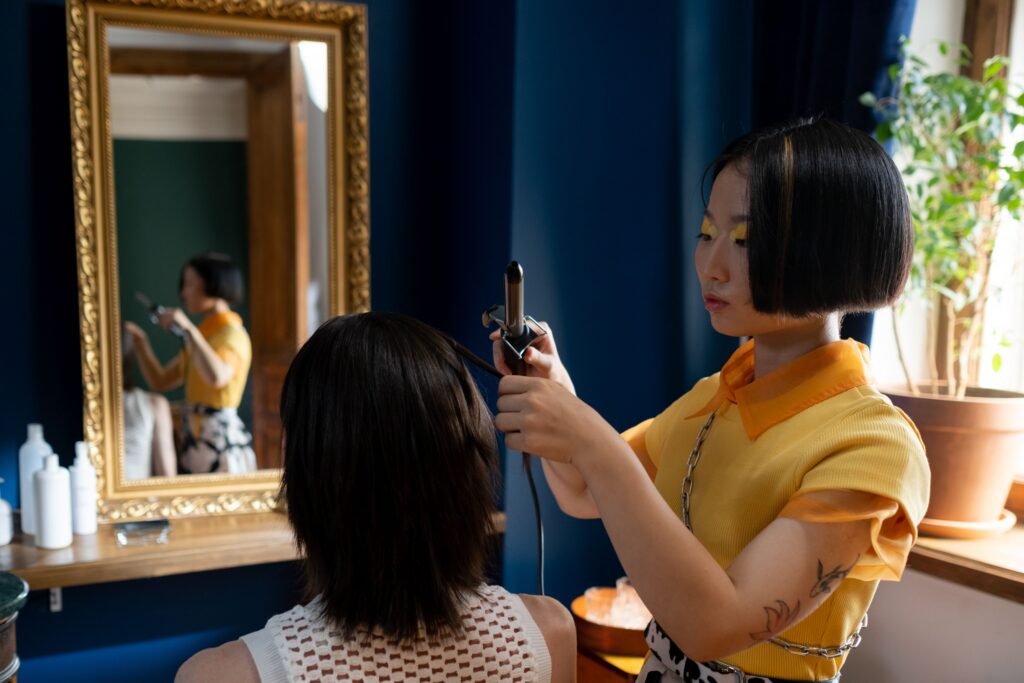
Walk into a successful hair or beauty salon five years from now and, at first glance, it may not look dramatically different. There will still be mirrors, chairs, basins, products and the familiar choreography of people cutting, colouring, treating and talking. But beneath the surface, almost every part of the business is likely to be changing. How customers discover a salon, how appointments are managed, how treatments are recommended, how staff build careers, how products are sold and even how water is used are all being reshaped at once.
That combination makes hair and beauty an unusually interesting industry to watch – even for someone ‘follicly challenged’ like me! It is becoming more technologically sophisticated at precisely the moment consumers are placing greater value on experiences that feel personal, trusted and human. My sense is that the businesses best positioned for the next decade will understand that these forces are not in conflict. Technology will increasingly take friction out of the salon experience, while human judgement, taste, skill and relationship become more valuable.
For salon owners and beauty leaders, that creates a different question from the familiar one of whether AI or automation will disrupt the industry. The more useful question is: as technology becomes capable of doing more, where will customers still insist on a human?
The workforce challenge may become the growth challenge
Any conversation about the future of salons has to start with people. Australia currently has about 65,400 hairdressers, according to Jobs and Skills Australia. Almost half work part-time, and median full-time earnings are $1,209 a week, compared with $1,852 across all occupations. Beauty therapy tells a similar story: the occupation is overwhelmingly female, has a median age of 33 and a high part-time share, while median full-time earnings on the older ANZSCO measure sit well below the all-occupation median.
Those numbers matter because the salon model is labour-intensive by design. A retailer can add another checkout machine. A software company can serve its next thousand customers at very low marginal cost. A salon generally needs another skilled pair of hands and another block of time.
The training pipeline adds another complication. NCVER’s 2026 completion-rate data shows that among the ten trade occupations with the most commencements in 2019, hairdressing had one of the lowest six-year apprenticeship completion rates at 47.6%. That does not mean the apprenticeship model is failing – trade completers overall have very strong employment outcomes – but it does underline how important retention, development and the quality of the early-career experience will be.
This is where I suspect the employment proposition inside salons will have to evolve. Younger workers are entering the labour market with high expectations around flexibility, learning, wellbeing and progression. In an industry already characterised by significant part-time work, the old assumption that loyalty is earned simply by offering someone a chair and a roster is unlikely to hold. The best operators will need to make the craft itself feel like a career: visible pathways, ongoing education, commercial skills, mentoring, specialisation and enough flexibility for talented people to imagine staying in the industry for the long haul.
Technology is moving from reception to the chair
For years, salon technology mostly meant operational technology: online booking, point-of-sale systems, appointment reminders, client databases and automated marketing. Those tools will continue to improve, and AI will make many of them less labour-intensive. Scheduling can become smarter. Client follow-up can become more personalised. Routine enquiries can be handled instantly. No-show risk can be managed more intelligently. The administrative layer of running a salon is likely to become substantially more automated.
But the more interesting shift is that technology is now entering the consultation and treatment itself. Kerastase‘s K-SCAN, for example, uses a 4K AI-powered camera to analyse the scalp and hair and is already being used across 9,000 salons. Its newer K-SPA concept combines that diagnostic layer with technologies including deep cleansing, micro-misting, massage and light-based treatment.
That is a useful glimpse of where professional beauty may be heading. Imagine arriving for an appointment and your stylist or therapist already has a detailed history of previous treatments, images showing how your hair or skin has changed, a technology-assisted assessment of its current condition and recommendations tailored to you. The professional is not replaced by the technology. They are better informed by it.
This distinction matters. Beauty is full of decisions that combine objective information with subjective judgement. A camera may detect scalp condition; it cannot fully understand how adventurous a client feels before an important event. An algorithm can recommend a colour; an experienced colourist knows whether that shade will suit the client’s lifestyle, maintenance tolerance and personality. The machine may increasingly supply the data. The professional still supplies context.
The customer journey may begin with an AI, not a search box
There is another technology shift salon owners should be watching, and it is happening before the customer even walks through the door. In June 2026, L’Oréal and OpenAI announced a collaboration that will bring Maybelline New York‘s virtual makeup try-on directly into ChatGPT. It is an early example of beauty discovery moving inside conversational AI.
Extend that trajectory and the implications for salons become significant. Consumers will increasingly ask AI which haircut suits their face shape, which colour complements their complexion, what treatment might help a dry scalp, which products fit their budget or which nearby salon specialises in textured hair. In other words, the next generation of search may not present consumers with ten blue links and ask them to choose. It may make a recommendation.
That raises the stakes for digital reputation. Accurate service descriptions, strong reviews, specialist expertise, useful content, clear pricing and consistent information across the web become more than marketing assets. They become signals that answer engines can use when deciding which businesses to surface. The salon that is easiest for an AI to understand may increasingly be easier for a customer to discover.
Beauty is becoming part of wellness
At the same time, the boundaries of the industry are expanding. McKinsey & Company expects the four core beauty categories – skin care, cosmetics, hair care and fragrance – to reach about US$590 billion globally by 2030. But surrounding those categories is a much larger ecosystem that includes aesthetics, sun care, supplements, spa services and other forms of personal care and wellness.
Younger consumers are helping accelerate that convergence. McKinsey’s 2025 wellness research found Gen Z and millennials accounted for 36% of the US adult population but more than 41% of annual wellness spending. For Gen Z specifically, appearance had moved from the sixth-most-important dimension of wellness in 2023 to third in 2024. Younger consumers also place more emphasis on skin and hair care and are experimenting with a wider range of wellness products and services.
That changes what a salon can represent. Scalp care can sit somewhere between hairdressing and wellbeing. Skin treatments increasingly overlap with preventative aesthetics. Products can extend the relationship beyond the appointment. A hair or beauty professional may become part stylist, part educator and part trusted navigator through an increasingly confusing market of products, treatments, devices and claims.
There is an opportunity here, but also a warning. As beauty moves closer to health and wellness, credibility matters more. Professionals will need to be clear about where their expertise ends, particularly when clients present medical concerns. The strongest businesses will broaden their value without pretending to possess expertise they do not have.
Consumers are becoming harder to impress
The beauty customer is also becoming more demanding. After years of inflation and relentless product launches, consumers are paying closer attention to value. McKinsey’s 2025 beauty research found shoppers increasingly sceptical of hype and focused on whether products actually deliver. Almost half of global consumers like to shop across price points, mixing premium products with cheaper alternatives.
That behaviour has implications well beyond retail shelves. A premium salon cannot assume that a premium-looking environment automatically justifies a premium price. Customers can research products, compare reviews, watch professionals demonstrate techniques online and arrive at an appointment with far more information than they once had. They may happily pay more, but they increasingly want to understand why.
For salons, value will therefore become less synonymous with cheapness and more closely tied to outcome. Expertise, consistency, personalisation, convenience, trust and experience all become part of the value equation. So does the ability to save the customer time. The appointment that starts on schedule, remembers the client’s preferences, minimises unnecessary waiting and makes rebooking effortless may feel more premium than marble benches and complimentary sparkling water.
Generational differences matter – but attitudes may matter more
Beauty has always been sensitive to generational change, and Gen Z is clearly shifting the category. Social media has accelerated experimentation, appearance is increasingly framed as part of wellness, and younger consumers are more comfortable moving between digital and physical beauty experiences. But there is a danger in designing an entire strategy around age.
McKinsey’s beauty research suggests attitudes are often more useful than simple demographics for understanding how people buy. Two 25-year-olds can have completely different relationships with beauty: one may obsessively research ingredients and treatments, while another wants the simplest possible routine. One may see a salon visit as indulgence; another as maintenance; another as self-care.
For operators, this points towards a more granular form of personalisation. Rather than asking only who the customer is demographically, ask what they are trying to achieve. How much maintenance are they willing to tolerate? How price-sensitive are they? Do they want experimentation or predictability? Are they seeking transformation, wellness, convenience or a familiar ritual? The answers may tell you more than their birth year.
Sustainability will have to become practical
Environmental expectations are changing too, but perhaps not in the way many brands expected. Consumers still care about sustainability, yet McKinsey’s beauty research suggests willingness to pay extra for it has softened, and refillable packaging has struggled to gain broad acceptance. The lesson is not that sustainability no longer matters. It is that consumers increasingly expect it without wanting to sacrifice efficacy, convenience or experience.
That makes salons a particularly interesting laboratory for practical sustainability because some of their environmental impacts are operational. Water, energy, aluminium, plastics, product waste and hair waste can all be addressed behind the scenes. L’Oréal‘s Water Saver technology, for instance, can reduce water use at the salon backbar by up to 69% compared with an average salon flow in France. The company’s professional division says more than 62,000 salons have adopted at least one of its sustainability solutions since 2022.
This is likely to be the more durable model: sustainability that also improves the economics or efficiency of the business. Saving water can lower resource use and cost. Smarter stock management can reduce waste. More efficient dryers can reduce energy consumption. Recycling systems can divert materials that would otherwise go to landfill. The environmental benefit becomes embedded in how the salon operates rather than relying on the customer to make a more inconvenient choice.
The paradox of the future salon
Put these shifts together and an interesting paradox emerges. Hair and beauty will become more digital, data-rich and automated, but the industry’s most defensible advantage may be the part that technology struggles to reproduce.
There are plenty of beauty activities consumers can already do at home, and the list will grow. AI can recommend products. Virtual try-on can preview a look. Devices can analyse skin and hair. At-home technology will become more capable. Yet people continue to seek professionals because information is not the same as judgement, and a transaction is not the same as an experience.
A great stylist notices hesitation. A therapist earns permission and trust. An experienced professional knows when a client is asking for one thing but describing another. They combine technical skill with taste, empathy and accumulated pattern recognition. They also provide something increasingly scarce in a digitally mediated world: sustained, face-to-face human attention.
That is why I suspect the salon of the future will not win by choosing between technology and humanity. It will use technology to remove the parts of the experience that feel transactional, repetitive or wasteful, freeing people to spend more time on the parts customers actually value.
The appointment may be booked by an AI, informed by a diagnostic camera, supported by a detailed digital history and followed up automatically. But when the customer sits in the chair, the reason they come back may still be remarkably old-fashioned: they trust the person standing behind it.
Michael McQueen is a globally recognised trend forecaster, change strategist and keynote speaker.
A bestselling author of 10 books, Michael’s latest release was named by Malcolm Gladwell and Adam Grant as one of the top five must-read new leadership books. He is a sought-after media commentator, with his insights regularly featured in Forbes, The Guardian, and CNN.
To find out more about Michael and his work, click here.
NOTES
Jobs and Skills Australia. “Hairdressers.” Occupation and Industry Profiles. Data include ABS Labour Force Survey 2025 annual averages, February 2026 trend data, and ABS Survey of Employee Earnings and Hours, May 2025. https://www.jobsandskills.gov.au/data/occupation-and-industry-profiles/occupations-anzsco/3911-hairdressers.
Jobs and Skills Australia. “Beauty Therapists.” Occupation and Industry Profiles. Data include ABS Labour Force Survey 2025 annual averages, February 2026 trend data, and ABS Survey of Employee Earnings and Hours, May 2025. https://www.jobsandskills.gov.au/data/occupation-and-industry-profiles/occupations-anzsco/4511-beauty-therapists.
National Centre for Vocational Education Research. Apprentice and Trainee Completion Rates 2025. July 28, 2026. https://www.ncver.edu.au/research-and-statistics/publications/all-publications/apprentice-and-trainee-completion-rates-2025.
National Centre for Vocational Education Research. Apprentice and Trainee Outcomes 2025. March 25, 2026. https://www.ncver.edu.au/research-and-statistics/publications/all-publications/apprentice-and-trainee-outcomes-2025.
L’Oréal Groupe. “K-SPA – Kérastase.” Updated June 2026. https://www.loreal.com/en/articles/science-and-technology/kspa/.
L’Oréal Groupe. “L’Oréal and OpenAI Join Forces for Transformation in Beauty with AI.” June 17, 2026. https://www.loreal.com/en/press-release/research-and-innovation/l-oreal-and-openai-join-forces-for-transformation-in-beauty-with-ai/.
Weaver, Kristi, Megan Pacchia, Sara Hudson, et al. State of Beauty 2025: Solving a Shifting Growth Puzzle. McKinsey & Company and The Business of Fashion, June 9, 2025. https://www.mckinsey.com/industries/consumer-packaged-goods/our-insights/state-of-beauty-2025.
Pione, Anna, Jonathan Medalsy, Kristi Weaver, Shaun Callaghan, and Stefan Rickert. “The $2 Trillion Global Wellness Market Gets a Millennial and Gen Z Glow-Up.” McKinsey & Company, May 29, 2025. https://www.mckinsey.com/industries/consumer-packaged-goods/our-insights/future-of-wellness-trends.
McKinsey & Company. “A Close Look at the Global Beauty Industry in 2025.” August 28, 2025. Based on research involving more than 15,000 consumers across 13 markets and more than 100 beauty executives. https://www.mckinsey.com/industries/consumer-packaged-goods/our-insights/a-close-look-at-the-global-beauty-industry-in-2025.