
What's Your Curiosity Quotient?
Are you as curious as you think you are?
Most of us would probably describe ourselves as curious.
But when was the last time you changed your mind about something you were absolutely certain of? Or deliberately tried something unfamiliar, just to see what might happen?
Curiosity isn’t simply about wanting to know more. It has a lot to do with how willing we are to question what we already know.
Inspired by the work of Pulitzer Prize-winning author Thomas Friedman, your Curiosity Quotient (CQ) offers a way to gauge just how curious you really are.
Take this 25-question Curiosity Quotient assessment and discover your CQ today.
Why Does Your Curiosity Quotient Matter?
We’ve spent decades measuring qualities like IQ and EQ. But in a world defined by accelerating change and uncertainty, I believe another quality matters enormously: CQ, your Curiosity Quotient.
Having spent more than two decades helping leaders and teams navigate change, I’ve noticed a pattern.
The people who thrive in uncertainty aren’t necessarily the smartest. They’re not the most experienced. They’re the most curious.
The challenge is that as we get older, we become more knowledgeable, more experienced and often more certain of what we know.
And what we know can easily get in the way of what we need to learn.
Curiosity shows up in our willingness to question our assumptions, explore unfamiliar ideas, stay open when we don’t have all the answers and change our minds when new information emerges.
The good news is that curiosity isn’t fixed.
It’s something we can strengthen.
But first, it’s worth finding out just how curious we are.
How Curious Are You? Let’s Find Out.
The following 25 questions will give you a snapshot of your CQ and help you understand how you approach new ideas, uncertainty and unfamiliar experiences.
For each statement, choose how much you agree or disagree.
There are no right or wrong answers. And there’s no point choosing what you think the curious answer should be.
Just answer as honestly as you can. You might find a few of your answers interesting.
Can You Learn to Become More Curious?
Unlock the Power of an Open Mind
When we’re young, we question everything. Yet as we age, our capacity for curiosity fades as we instead seek fast, easy certainty.
In short, we get complacent.
And that complacency can hold us back from our true potential.
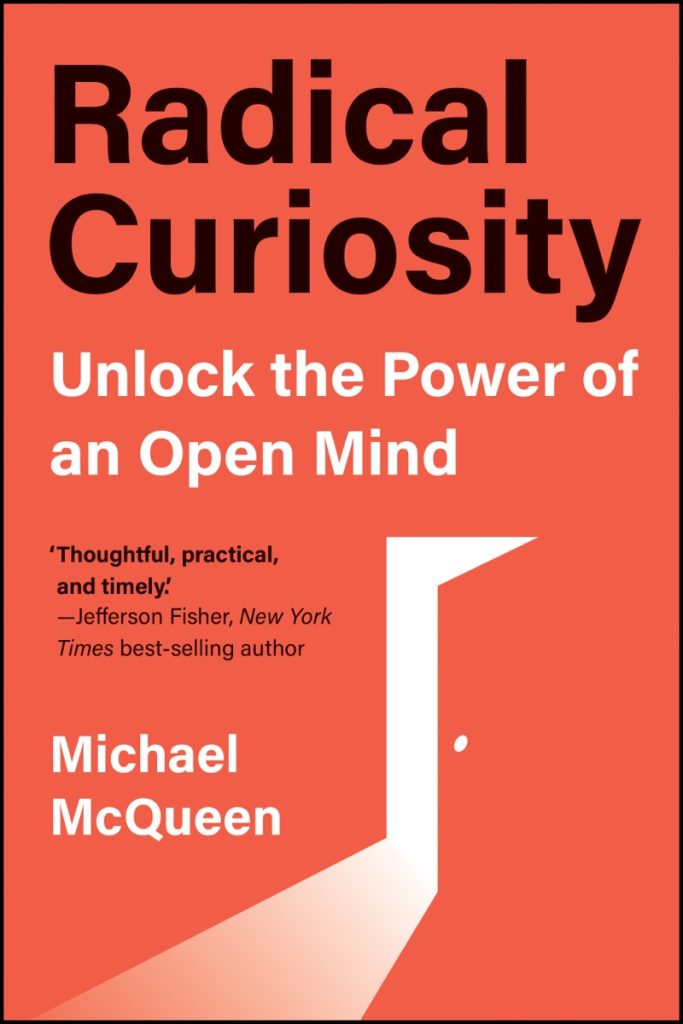
In my new book, Radical Curiosity: Unlock the Power of an Open Mind, I explore why curiosity isn’t something we need to learn as much as something we need to relearn.
Drawing on behavioural science, stories and practical ideas, the book explores how to:
- Microdose novelty with small, deliberate challenges.
- Spot opportunities that others overlook.
- Lower the cost of changing your mind.
- Let go of the need to always have the answer.
- Prevent your experience from becoming a blind spot.
In a world where no-one can be certain of what’s coming next, curiosity is no longer just a nice idea. It’s a necessity.
Frequently Asked Questions About Your Curiosity Quotient
What is a Curiosity Quotient (CQ)?
Your Curiosity Quotient, or CQ, is a way of exploring how curious you are. It considers how you approach unfamiliar experiences, question your assumptions, respond to uncertainty and remain open to changing your mind.
Michael McQueen’s 25-question assessment provides a snapshot of your current curiosity score.
How can I find out my Curiosity Quotient?
You can take Michael McQueen’s online CQ assessment by answering 25 statements about how you think and respond to different situations. For each statement, you indicate how much you agree or disagree. Your responses are used to calculate your curiosity score.
Can you improve your Curiosity Quotient?
Curiosity isn’t fixed. As Michael explains in Radical Curiosity, it’s something we can strengthen. By introducing small, unfamiliar experiences into everyday life, questioning our assumptions and becoming more comfortable with uncertainty, we can develop the habits that help us remain curious.
Why do adults become less curious?
As children, we’re naturally curious. We ask questions, explore the unfamiliar and learn by trying things out. But as we get older, we often become more comfortable with what we know. We develop routines, rely on our experience and become less inclined to question our assumptions. Michael explores why this happens and how we can relearn our natural curiosity.
Is curiosity the same as intelligence?
No. Intelligence and curiosity are different qualities. Intelligence relates to our ability to learn, understand and apply knowledge, while curiosity concerns our willingness to question, explore and discover. Michael’s work examines why curiosity matters so much in situations where existing knowledge and experience may not be enough.
How long does the Curiosity Quotient assessment take?
The CQ assessment contains 25 questions and takes just a few minutes to complete. There are no right or wrong answers. Simply choose the response that best reflects how you normally think or behave.
What can I do to become more curious?
One of the techniques Michael explores in Radical Curiosity is Microdosing Novelty. It involves introducing small, deliberate new experiences into everyday life. Trying something unfamiliar, questioning a long-held assumption or approaching a familiar situation differently can help us become more open to learning something new.